Where Golden Edges and Ghee Aroma Fill the Air
A dosa starts with a sound. Pale, fermented batter hits a hot cast-iron griddle, hisses, and within seconds the edge turns golden and lacy. Ghee warms the air. Rice and lentils, ground and left to ferment, become something people will drive across town for. That rhythm runs through the whole dosa corner Columbus scene.
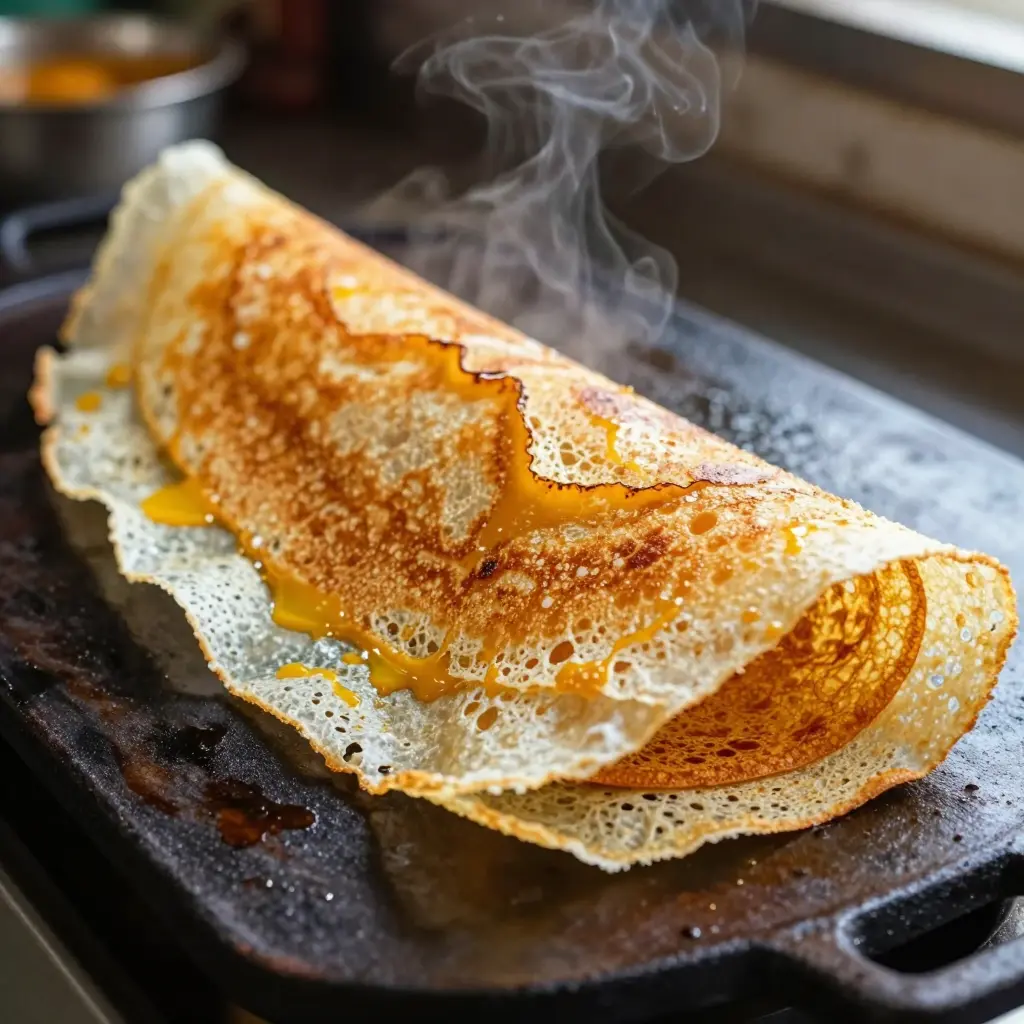
Ask anyone who eats South Indian dosa Columbus style, and the order usually goes one of two ways: ghee roast or paper roast. The ghee roast comes thick and soft, its surface glossy while clarified butter steams off the plate. The paper roast is a different thing altogether, spread so thin it is rolled into a scroll that cracks at the lightest touch. For most people the choice depends on mood more than appetite. Both are good, and both have their regulars.
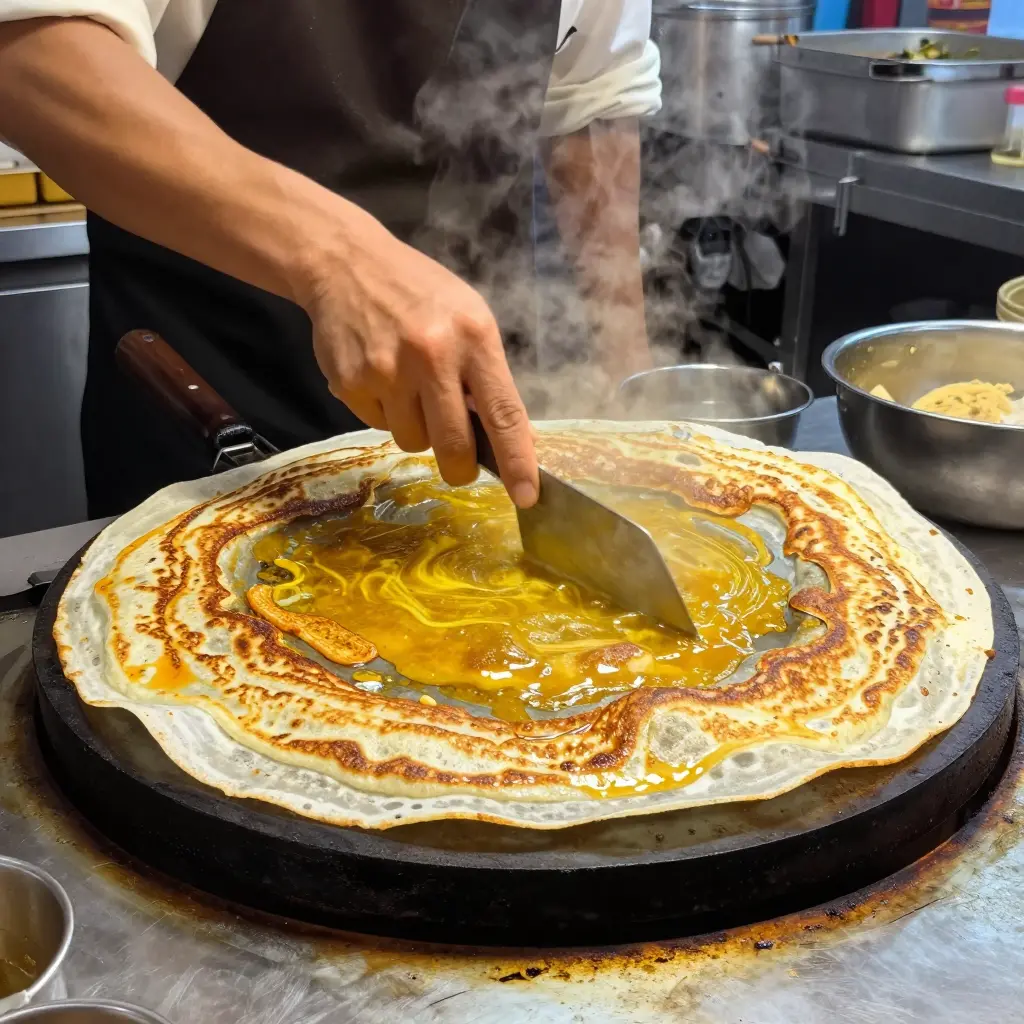
What decides which one you get is how the batter is spread. A slow spiral outward from the center leaves a thicker layer that steams as much as it fries, giving a soft, chewy bite. A fast, light sweep all the way to the rim pulls the batter paper-thin, so the moisture escapes and the dosa turns brittle and glassy. Same recipe, same griddle. The wrist decides, and that is why two dosas from the same bowl can eat like two different dishes.
Golden edges, crackle, warmth: it comes down to feel, heat, and timing. Once you understand the spread, you notice the small differences on every plate, and the ghee roast vs paper roast argument gets more interesting. The rest of this dosa corner Columbus guide digs into the details.
What Makes a Dosa a Dosa
A dosa is simple at its core. Soak rice and urad dal, grind them to a smooth paste, and give it time. That paste is your dosa batter, and everything else follows from it. During fermentation, enzymes break the starches down into sugars, and wild yeast and lactic-acid bacteria consume those sugars, producing carbon dioxide and acid. The gas puffs the batter up; the acid gives it a mild sourness. That is what makes a fermented dosa taste alive: lightly sour, a little nutty, ready for heat. Fermentation affects the crust too. Sugars left on the surface brown when the batter hits the tawa, and that browning is what gives you the golden, lacy edge.
The cooking surface matters just as much. A dosa goes onto a flat cast-iron or non-stick tawa, heated until a drop of water skitters across it. Ladle the batter, then spread it in quick spirals from the center out. Spread thin and you get delicate and crackly; spread thick and you get soft and pillowy. Same batter, different results, all because of the spread.
That one variable explains why a paper roast shatters and a ghee roast stays tender and rich. When you bite into a crispy dosa Columbus kitchens turn out well, you are tasting fermentation, heat, and technique at once. To try the real thing, visit our dosa corner in Columbus.
Ghee Roast Dosa: The Slow, Golden Art of Depth
The ghee roast dosa starts with a heavier pour. Rather than the feather-thin swipe used for a paper roast, the batter is layered a touch thicker and spread in gentle concentric spirals, so the center stays soft and pillowy. The extra thickness is not a mistake; it is the point. It holds moisture in the middle, which keeps the dosa tender while the outer edge turns crisp and glossy.
Then comes the patience. A ghee roast cooks lower and slower on the tawa, letting the heat work through the batter instead of flash-frying the surface. Spoonfuls of ghee pool around the edge and bubble into the batter, basting it from below. The result is a rich, nutty crisp at the rim with a center that stays soft, chewy, and faintly custardy. That slow technique is what makes a true ghee roast dosa Columbus diners keep coming back for.
The ghee brings a warm, toasted aroma with notes of caramel and browned butter. Slow cooking rounds off the fermented tang of the batter, making it more savory. Each bite goes from crackle at the edge to a soft, buttery chew in the middle, with the ghee coating your tongue. If you have typed “dosa near me” and ended up with something flat, this version resets the standard. To taste the difference, explore the dosa corner Columbus menu.
Flavor summary at a glance:
- Aroma: warm ghee, toasted butter, faint caramel sweetness
- Texture: shatteringly crisp rim over a soft, chewy center
- Taste: deep fermented tang balanced by rich, nutty ghee
- Finish: glossy, lingering, and gently savory
Paper Roast Dosa: The Art of the Featherweight Crisp
A paper roast dosa is thin enough that you can almost see the tawa through it. The cook ladles a small amount of batter and draws it outward in one wide, confident circle until it reaches the pan’s edges. What arrives is a golden spiral, rolled into a translucent curl that weighs almost nothing and breaks at the lightest pressure.
That shatter is the point. Where a ghee roast soaks up butter for a soft, layered chew, a paper roast stays lean and brittle, cracking and dissolving into a light, toasty crunch. Because every bite is so light, the tang of the fermented batter and the warmth of the chutneys come through clearly. If you like that snap, the crispy dosa favourites on the menu are worth ordering.
That texture takes precision. The griddle has to be hot enough to set the batter on contact but not so hot that it burns before it crisps, and the pour has to be fast and even. Miss the timing and you get a pale, floppy disc instead of a thin, crisp one. A good paper dosa Columbus kitchens serve is a test of skill as much as a menu item; the thin crispy dosa is the proof.
Here is how ghee roast vs paper roast differ once the batter hits the hot griddle.
| Dosa Type | Batter Thickness | Spread Technique | Cooking Heat | Cooking Time | Texture | Crispness Level | Dominant Flavor | Best For |
|---|---|---|---|---|---|---|---|---|
| Ghee Roast Dosa | Medium to slightly thick, left a touch heavier on the tawa | Gentle, circular swirl spread to a soft-edged medium round | Medium heat, so the ghee sizzles without scorching | Roughly 3-4 minutes, flipped once for an even golden blush | Pillowy and pliable in the center with lacy, ghee-crisped edges | Moderate crispness that yields to a buttery chew | Rich, nutty, aromatic ghee that coats every bite | A hearty, indulgent meal and first-timers craving that classic buttery finish |
| Paper Roast Dosa | Thin, watery batter thinned for maximum flow | Fast, wide spiral spread pulled paper-thin across the whole tawa | High heat for a quick, blistered set | About 60-90 seconds, often left unflipped | Feathery, almost translucent with a delicate crackling snap | Extremely high, shatters at the lightest touch | Clean, toasted rice-and-lentil tang with a whisper of oil | Sharing as a showpiece and pairing with chutney or sambar for a light, crunchy feast |
Whether you prefer butter-soft or glass-thin, the ghee roast vs paper roast question is best settled in person at a dosa corner Columbus kitchen that makes both well.
The Science: How Batter Spread Changes the Crisp
Think of the ladle as a paintbrush and the tawa as the canvas. Batter spread is a race against time: the faster and wider you swirl, the thinner the film of dosa batter you leave behind, and the more that film behaves like a sheet of paper rather than a pillow of dough. A thin layer lets heat from the tawa reach the center almost immediately, so the batter sets before steam can build up and puff the middle. A thick, lazy pour traps that steam, and trapped steam means a soft, spongy bite.
This is where surface area to volume ratio matters. Spread the batter wide and you increase the surface touching the hot metal while shrinking the volume of batter that has to dry out. More contact means faster evaporation, and faster evaporation firms up the crust instead of leaving it steamy and flexible. It is the same reason a thin smear of paint dries in minutes while a thick glob stays tacky for hours.
Once the surface dries, the crispy dosa science takes over. The browning comes from the Maillard reaction, in which sugars and amino acids react under heat. It needs a dry surface: while water remains, evaporative cooling holds the surface near the boiling point, too cool for the reaction to run quickly. A thin batter spread sheds its water fast, letting the surface climb past that point and turn deep golden and toasted.
So a paper-thin spread means more contact with the tawa, faster moisture loss, and a shatter-crisp result, while a thicker pour holds its steam and keeps the interior tender and slightly chewy. Neither is wrong; they are two textures from the same bowl. On any given evening the choice comes down to mood, and at a dosa corner Columbus spot, that mood is easy to order.
How Batter Spread Changes the Crisp: A Visual Guide
The diagram below shows the batter-spreading sequence on a round tawa (griddle): three steps that decide whether you end up with a thick ghee roast or a featherweight paper roast.
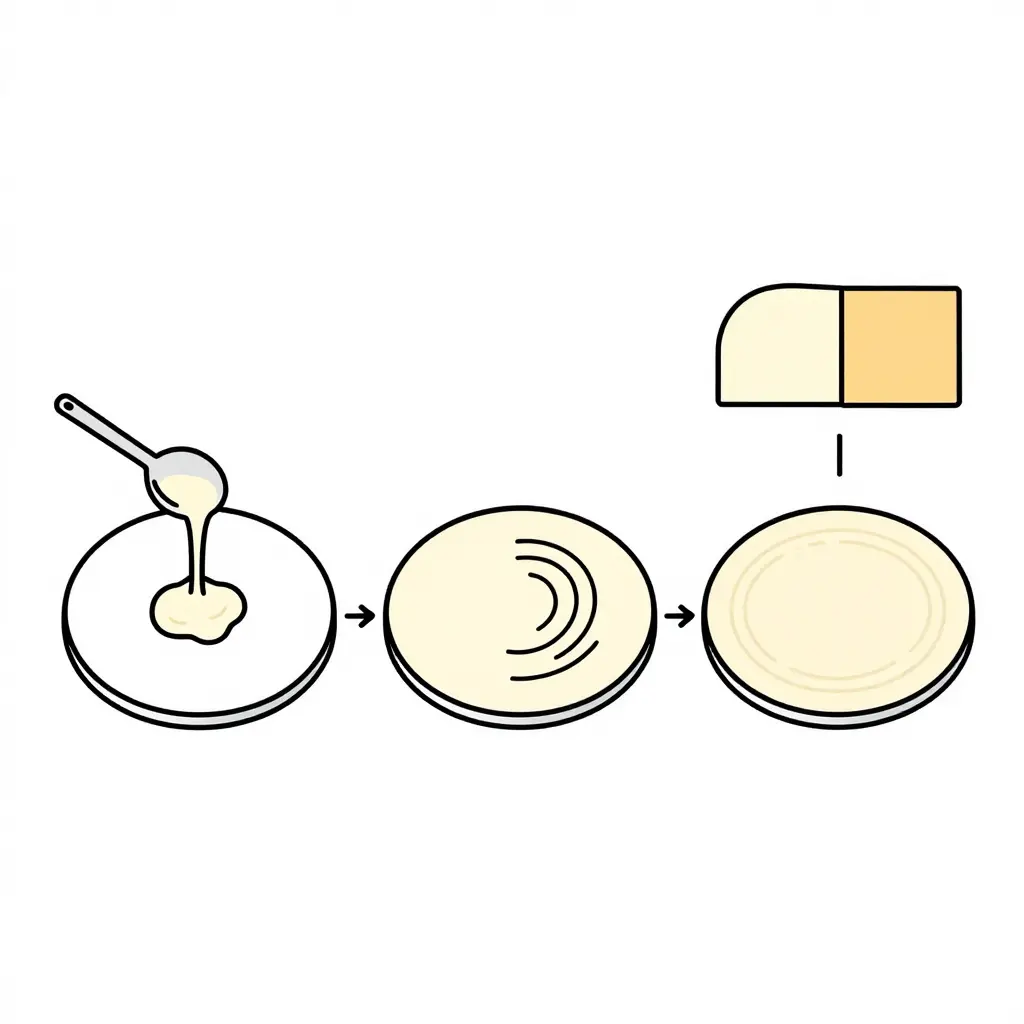
What the diagram shows:
- Step 1 – Center ladle: A single ladle of batter is dropped right at the middle of the hot tawa.
- Step 2 – Spiral outward: A curved arrow traces the batter spiraling out from the center in one continuous, confident sweep.
- Step 3 – Full thin circle: The batter expands into a full, even circle – thin spread means a crispier, lace-like dosa; a thicker spread stays soft and fluffy.
- Side-view inset: A small cutaway compares a thin batter layer against a thick one, showing exactly why spread thickness drives the crunch.
Downstream image-generation prompt (for reference):
Minimalist 2D flat line-art instructional diagram, no realistic scenes or text. Show a dosa batter spreading sequence on a round tawa in three steps left to right: a ladle at the center, a spiral arrow spiraling outward, and a fully spread thin circular dosa with faint concentric lines. Use clean thin black outlines, simple circles, and clear motion arrows. Add a small side-view inset comparing a thin batter layer versus a thick batter layer as thin vs thick horizontal slabs. White background, monochrome line-art with one warm accent color.
Come see it firsthand at our Dosa Corner in Columbus.
From Ladle to Lace: How Your Spread Technique Decides Soft vs. Shatter-Crisp
The dosa spread technique decides whether you end up with a pillowy disc or a glassy, shattering one. Same batter, same tawa, very different plate. Ladle size, batter thickness, pan heat, and the pressure you apply while circling all determine where a dosa lands on the soft-to-crisp scale.
Start with the ladle and dosa batter thickness. A large ladle poured thick and left mostly unspread gives a soft, spongy ghee roast base, because the batter never thins enough to dry into a crisp film. A small ladle spread wide stretches the same batter into a thin sheet, which is how a paper roast begins. Batter that is too watery spreads easily but tears and steams instead of crisping; batter that is too thick clumps into a chewy center. Aim for a consistency that pours but still coats the ladle.
Tawa temperature and spread speed work together. A hot tawa sets the batter the instant it lands, which locks in crispness, but spread too fast on a cool pan and you get pale, gummy patches. Spread too slowly on a very hot tawa and the edges scorch before the center sets. The balance is a steady outward spiral: heat high enough to hiss, hands quick enough to cover the surface before the batter firms up. For the crunchy, golden finish of a crispy dosa Columbus kitchens get right, speed and heat have to match.
Pressure is the fine-tuning. A light swirl leaves air pockets and a delicate web that shatters at first bite, which is the texture of a true paper roast. Firmer pressure compresses the batter into an even, slightly denser round that stays tender, the signature of a ghee roast. So ghee roast versus paper roast is not only a menu label; it is a spreading decision made in a few seconds. If you would rather skip the trial and error, you can always find a crisp dosa near you.
Crispness & Texture by Dosa Style
The bars below compare Ghee Roast and Paper Roast on a 1-10 scale, where higher scores mean more of that quality: a taller gold bar signals a thicker, richer ghee roast, while a taller orange bar signals a thinner, extra-crisp, faster-cooking paper roast.
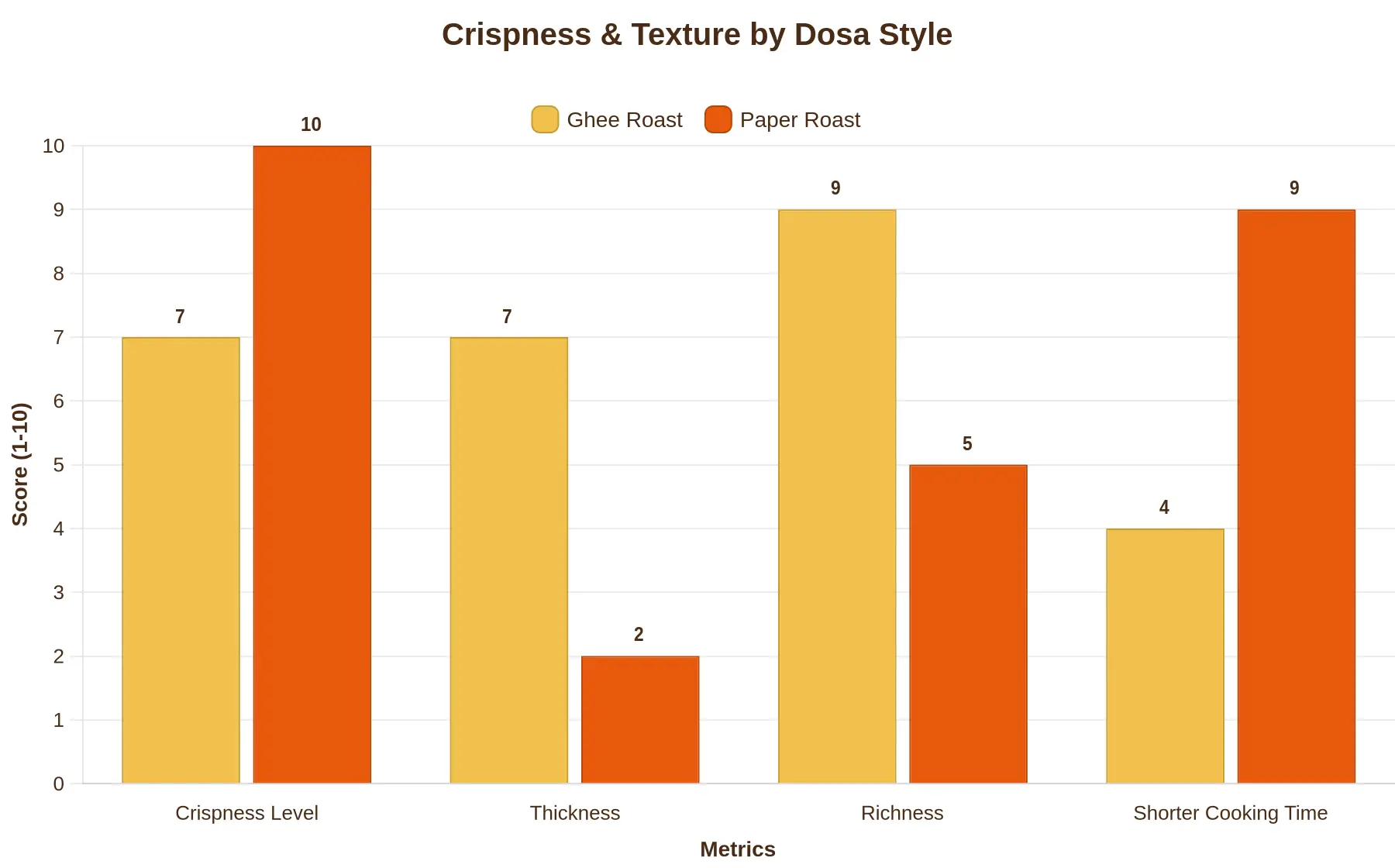
Insight: In the ghee roast vs paper roast comparison, the paper roast scores higher on crispness and speed, while the ghee roast scores higher on thickness and richness. How you spread the batter shapes the result.
To taste the difference, order both at our Dosa Corner in Columbus.
What Affects Dosa Crispness
Why does one dosa shatter like a thin sheet of glass while another turns out soft and floppy? It is not luck. Here are the variables that decide it:
- Batter fermentation level – Well-fermented batter traps gas and acid, giving you that lacy, golden crunch; under-fermented batter stays dense and chewy.
- Rice-to-lentil ratio – More rice means a crispier, thinner texture, while extra urad dal softens the bite and adds fluff.
- Batter consistency – A loose, pourable batter spreads thin and fries fast, but a thick one sits heavy and steams instead of crisping.
- Tawa temperature – A hot, well-seasoned tawa sets the batter instantly for a shatter-crisp finish, while a lukewarm one leaves the dosa pale, gummy, and slow to crisp.
- Ghee or oil quantity – Generous ghee around the edges fries the dosa into a buttery, roasted crisp, whereas too little leaves it pale and leathery.
- Spreading thickness – The thinner you spread, the crisper the result; a thicker pour keeps the center soft and pillowy.
- Resting time before serving – A dosa eaten straight off the tawa stays crackly, but one left to rest on a plate traps steam and goes limp.
Get these working together and your dosa batter will turn out crisp consistently. That is the balance our kitchen aims for on every order at the dosa corner Columbus counter.
Exploring Authentic Dosa in Columbus: What to Look For
A genuine dosa corner Columbus experience starts before the plate reaches the table, with the batter. Look for a kitchen that ferments its own rice and urad dal overnight; a well-rested batter is what gives the dosa its faint tang and slightly puffed texture. If it smells flat or tastes dull, the fermentation was not right.
Watch the tawa as well. A proper South Indian dosa Columbus kitchen treats heat like an instrument, spreading the batter in one confident swirl across a griddle that is hot but never scorching. That temperature is the difference between a dosa that shatters under your fork and one that steams into a rubbery pancake.
Order made to order. Dosas that sit under a warmer lose their crunch; a good one reaches the table still crackling, with an even golden-brown surface. Skim a dosa place’s Sterling menu to see how many variations a kitchen is willing to make fresh, and check a helpful dosa corner Columbus guide for what to order first. Get the coconut chutney and sambar, and take your time with it.
Wrapping It Up: Two Dosas, One Delicious Science
The rivalry behind a good dosa corner Columbus visit comes down to technique as much as taste. The ghee roast vs paper roast question is not a competition so much as a spectrum. A ghee roast leans into richness, its surface sizzling in clarified butter until it turns tender-crisp and aromatic. A paper roast chases pure, fragile crunch, stretched so thin it shatters at the first bite. What connects them is the batter spread: the outward swirl that decides how thin the dosa stretches, how evenly it cooks, and how crisp the final crispy dosa turns out. Spread it thin for a delicate snap; spread it thicker for a heartier chew with room for ghee.
If that has made you hungry, start with the real thing. Sri Ganesh Dosa House serves a South Indian menu made to order, and it is a good benchmark before you try it at home. With a well-seasoned tawa, a ladle of fermented batter, and a little patience, you can make crisp-edged dosas yourself. Every plate is a small experiment, and it tastes better shared. Thanks for reading, and good luck with your next batch.