Cold-Start Failures on Electric Loaders: An Operational Overview
Electric loaders are now common in ports, warehouses, and construction yards because they emit less and cost less to run. In winter they show a weakness that summer duty cycles never touch. The symptoms usually appear in three places. Units sit idle waiting on a charge the pack will not accept, so availability drops. Hydraulics respond slowly for the first minutes of a shift, as cold fluid and reduced current slow every lift and tilt. Occasionally a machine will not energize at all.
The symptoms are rarely random, and they usually come back to two causes. The first is too little battery pack preheating, which leaves lithium cells too cold to deliver rated current or take a fast charge without risking lithium plating. The second is a charger whose voltage, current profile, or thermal behavior does not match the pack it serves, so preheating either never runs or runs inefficiently.
Manufacturers specifying new machines, fleet managers planning winter operations, and engineers tuning thermal and charging strategies all have to deal with how these two factors interact. What follows covers the mechanisms behind cold-weather failures and the measures that improve first-shift reliability.
Common Cold-Start Failure Symptoms on Electric Loaders
The early signs of a cold-start problem are easy to miss. They show up as sluggish hydraulics, a charger that will not start, or a warning light that looks harmless until the machine stalls mid-shift. The list below is a quick reference for catching them before they cost you a shift.
-
Delayed hydraulic response. The boom or bucket takes noticeably longer to react after you pull the lever, because cold hydraulic fluid thickens and resists flow. Operators often describe the motion as “sticky” or lagging for the first few minutes of a shift.
-
Charger refusal to initiate. The charger connects but stays silent, flashing an error rather than pushing current into a frost-cold pack. This usually happens when the BMS blocks charging until cell temperatures climb above a safe threshold.
-
Reduced lift or dig force. The loader can raise or scoop, but it feels weak and struggles to break into compacted material. Falling system voltage under cold load cannot sustain full hydraulic pressure.
-
Unexpected BMS shutdown. The machine cuts power without warning, sometimes seconds after startup. The battery management system is protecting cells from voltage or temperature limits it considers unsafe.
-
Voltage sag warnings. Dashboard alerts flag falling voltage whenever a heavy load is applied. This points to a cold pack with high internal resistance that cannot deliver peak current on demand.
-
Slow travel speed. The loader creeps along well below its rated speed, and operators report a limp, unresponsive pedal. Low available power limits motor output until the pack warms up.
-
Increased energy consumption per operating hour. More kWh disappear per hour of work than usual, so runtime shrinks and charging cycles multiply. Cold cells plus preheating draw extra energy that never reaches the wheels.
-
Turtle or limp mode activation. The controller caps torque and top speed to prevent damage. Derating like this often means the pack was not preheated properly.
On their own, each symptom looks like a minor annoyance. Together they point to a specific fix: preheating, charger selection, or both. Track them across the fleet and the pattern shows up before it turns into downtime.
![Pack preheating system flow diagram showing cold battery pack, thermal sensor input, heating element or coolant loop activation, warmed cells, and a ready-to-operate pack in a numbered left-to-right process sequence]|https://sriganeshdosahouse.shop/wp-content/uploads/2026/09/img-cold-start-failures-on-electric-loaders-pack-prehe-1.webp)
The schematic shows the five stages of a preheating cycle: cold pack, thermal sensor input, heating element or coolant loop activation, warmed cells, and a pack ready to work.
Battery Pack Preheating Strategies for Electric Loaders
Below roughly 0 °C, electrolyte viscosity climbs, lithium-plating risk rises, and usable power falls sharply. The battery pack preheating strategies below trade off warm-up speed, energy cost, and hardware complexity in different ways, so fleets can pick what fits their duty cycle.
Active Liquid Heating
A pump circulates warmed coolant through channels wrapped around or embedded within the modules. This method spreads heat evenly across large packs and scales cleanly to big loader batteries. The price is complexity: pumps, valves, a heat exchanger, and heater elements add cost, weight, and maintenance points. Ramp-up is comparatively slow, yet the gentle, uniform warming suits packs that must stay at temperature for hours.
Resistive Film Heating
Thin, flexible films bonded to module faces or the baseplate warm quickly and locally. They are simpler and cheaper than a full liquid loop. The catch is uneven heat: cells nearest the film warm first, so weak thermal spreading invites hot spots and stratification. Energy overhead is moderate, and the films are easily damaged when packs are handled roughly.
Self-Heating via Controlled Internal Resistance
Rather than add external heaters, the battery management system deliberately pulses current so internal resistance generates heat inside the cells. Nothing extra is bolted onto the pack, keeping component complexity and cost low. The drawbacks: the pack must already accept some current, warming is slow at very low temperatures, and the algorithm needs careful tuning to avoid lithium plating.
Preconditioning the Electric Loader Before Shift Start
When a preconditioning electric loader stays tethered to a smart charger before the shift, the pack warms on shore power instead of eating into the day’s working range. Automate the schedule and operators climb into a machine that is already at temperature.
Trade-Offs: Speed, Energy, and Complexity
| Strategy | Heating Speed | Energy Overhead | Component Complexity |
|---|---|---|---|
| Active liquid heating | Moderate | Moderate | High |
| Resistive film heating | Fast | Moderate | Low to medium |
| Self-heating via internal resistance | Slow to moderate | High (battery-fed) | Low |
| Shore-power preconditioning | Moderate | Low (grid-fed) | Medium |
Why the Target Temperature Range Matters
Bringing the pack to roughly 15-30 °C before work pays off in two ways. Warm cells accept charge faster, so regenerative braking and top-up charging recover more energy and fast charging does not taper early. They also deliver higher sustained current, so the loader can climb grades and lift loads without derating. Staying in that band rather than overheating avoids accelerated aging.
Battery Pack Preheating Methods: A Side-by-Side Comparison
When a loader will not cold-start at -20 °C, the cause is usually a cold-soaked lithium-ion pack with sluggish kinetics rather than a weak motor. The fix depends on which preheating architecture the machine came with. The table below compares warm-up speed, energy loss, complexity, and cost across the four common options.
| Preheating Method | Typical Warm-Up Time | Energy Overhead | System Complexity | Best-Fit Use Case | Relative Cost |
|---|---|---|---|---|---|
| Liquid heating (PTC/coolant loop) | 10-25 min | High (3-6 kW drawn; pump and heater both parasitically loaded) | High (dedicated heater core, pump, plumbing, sealed channels) | Large high-voltage packs on loaders that must work full shifts in sub-zero outdoor sites | High |
| Resistive film / PTC blankets on cells | 20-40 min | Moderate (2-4 kW; some heat leaks to surrounding structure) | Low (adhesive films wired to a relay and controller) | Retrofit fleets, mid-size packs, and depot equipment needing simple, proven warmth | Low |
| Self-heating via internal resistance | 8-20 min (during controlled charge/discharge pulses) | High (battery-fed; reuses ohmic losses, but pulse current stresses cells) | Medium (bidirectional inverter plus precise BMS control logic) | Fast opportunity charging and frequent duty cycles where downtime must stay short | Medium |
| External warm storage (heated depot bay) | 45-90 min (or overnight maintenance) | Low to moderate (building-side power, heat loss through pack casing) | Low to medium (heater bay, insulation, spacing, monitoring) | Fixed-schedule fleets parking indoors overnight in a central garage | Medium |
How to Read the Table
- Warm-up time assumes a pack starting near -20 °C and a target of 0-10 °C before a hard load.
- Energy overhead is the parasitic load the preheater places on the machine.
- System complexity drives both your engineering hours and your service-part count, which matters for a loader working far from a workshop.
- Best-fit use case is where each method actually makes sense. Liquid heating is overkill on a compact unit, and a resistive film rarely keeps up on a very large pack.
Practical Takeaway for Buyers
Size the heater for the duty cycle rather than the spec sheet. Loaders that run multiple shifts in frozen yards usually repay a liquid loop through reduced idle time. If they park in a heated depot every night, external warm storage plus a resistive blanket is often cheaper and still keeps the pack ready before the first operator clocks in. Whichever you choose, pair it with a charger that reads temperature limits so the BMS never pushes full current into a cold pack.
Charger Selection Criteria That Prevent Cold-Start Failures
A loader that refuses to charge on a freezing morning often has a charger problem, not a battery problem. Charger selection for electric loaders means matching hardware and firmware to the pack’s real operating envelope rather than its nameplate numbers. The criteria below keep machines running in the cold.
Match the Charger Power Rating to the Pack
An undersized charger cannot deliver the current a cold pack demands, so it trips, derates, or times out before bulk charge even begins. Size the charger so its continuous output comfortably exceeds the pack’s acceptance rate at low temperature, leaving headroom for preheating loads.
Verify the Output Voltage Window
A charger’s voltage window must fully overlap the pack’s range, including the elevated terminal voltage seen during cold-weather preheat. A window that is too narrow aborts negotiation and blocks charge initiation.
Insist on a Temperature-Aware Charging Profile
A temperature-aware charging profile adjusts voltage and current targets as pack temperature shifts, ramping gently in the cold instead of forcing full current into sluggish cells. This one feature prevents many cold-start refusals.
Cap Cold-Weather Charge Current
Below roughly 0°C, lithium cells must be charged at reduced current until they warm. The charger should accept a BMS-driven current limit and honor it rather than defaulting to its maximum.
Confirm CAN Compatibility with the BMS
The charger must speak the same protocol, baud rate, and message set as the battery management system. Without CAN compatibility, the two never agree on readiness, and charging stalls at the handshake.
Choose a Weather-Rated Enclosure
A charger rated for rain, dust, and ice (IP54 or better) avoids moisture and thermal faults that mimic battery problems.
Why Misconfiguration Strands Machines
An undersized or misconfigured charger fails at the same handshake, so the operator returns to a machine that was never charged and a stranded loader blocks the production cycle.
Charger Output Current by Ambient Temperature
How much current a charger can deliver depends on ambient temperature and on whether it works with a cold pack or against it. The chart compares a standard charger (no pack preheat) with a temperature-aware charger (with pack preheat) across four ambient bands from -20°C to 20°C.
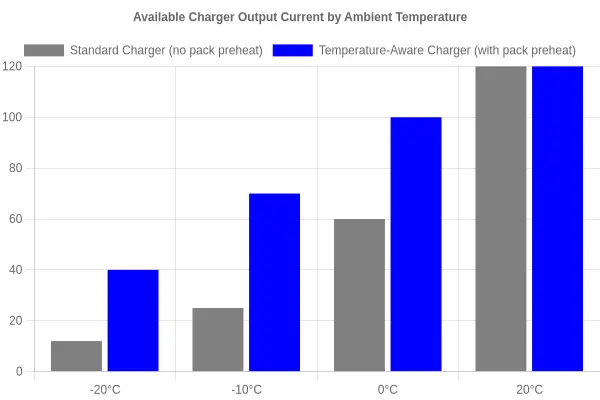
At 20°C both configurations reach full output (120 A). As temperature falls the gap widens: at -20°C the standard charger delivers just 12 A while the temperature-aware unit holds 40 A, more than three times the usable current. A mismatched charger does not charge slowly in the cold so much as lose most of its capacity right when the loader needs it.
| Ambient Temp | Standard Charger (A) | Temperature-Aware Charger (A) | Output Retained (Standard) |
|---|---|---|---|
| -20°C | 12 | 40 | 10% of rated |
| -10°C | 25 | 70 | 21% of rated |
| 0°C | 60 | 100 | 50% of rated |
| 20°C | 120 | 120 | 100% of rated |
What This Means for Fleets and OEMs
- Cold starts are also a charger-selection problem. Pairing a loader with a charger that ignores pack temperature creates a capability cliff below 0°C.
- Temperature-aware charging plus pack preheating keeps the electrolyte warm enough to accept higher current, so the pack reaches target charge sooner.
- Specify for the coldest band you operate in. Where sub-zero mornings are normal, the -20°C column sets your duty cycle, not the 20°C rating.
If your charger’s curve falls off the way the grey bars do, revisit preheating and charger selection before winter deployment.
Integrating Preheating with Charger Selection
Where the Split Causes Failures
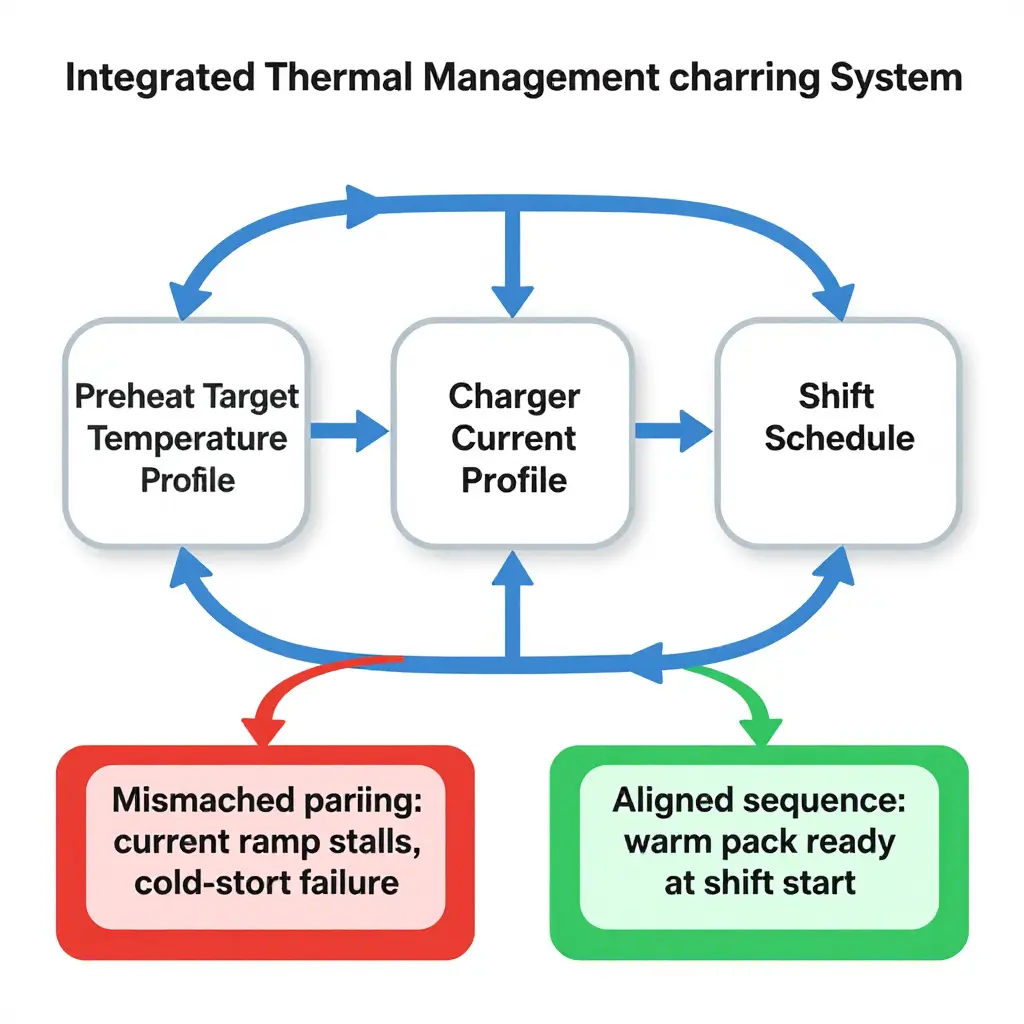
Preheating and charger selection are often owned by different teams on different timelines. The thermal group sizes the heater; the electrical group picks the charger. The pack’s target preheat temperature, the charger’s current profile, and the shift schedule are one coupled system. Treat them as independent variables and a design that looks fine on paper can still refuse to move at 5 a.m.
Why Mismatched Pairing Fails
The problem shows up on the first frosty morning. A charger rated for the pack’s nominal voltage may use a current profile that assumes a warm pack, ramping to full constant current as soon as the coupler locks. A cold lithium pack cannot absorb that current without voltage sag and plating risk. The BMS clamps the current, the ramp stalls, and the preheat never reaches its target before the shift. Reverse the mismatch and an oversized heater chasing an aggressive target drains the energy the charger was meant to store.
Designing One Loop Instead of Two
These decisions have to be co-designed. Fix the preheat target temperature first, derive the charger’s current profile from what the cold pack can accept at that temperature, then work the warm-up sequence back from shift start so the pack is ready when the operator begins. That is what integrated thermal management charging means in practice: one thermal model, one schedule, and one charger curve, designed together.
Cold-Weather Operational Best Practices for Electric Loader Fleets
Most cold-start failures come back to a few daily habits, and the fixes are simple. The checklist below works as a yard operating standard whenever the temperature drops below freezing.
- Preheat on a schedule: Begin pack preheating 60 to 90 minutes before the first shift using the on-board heater or an external charger with preheat capability. Waiting until operators climb aboard means a sluggish, high-resistance start.
- Plug in whenever parked: Treat every idle period as a charging opportunity so the thermal management system can keep the pack warm off shore power. Unplugged machines shed heat fast and pay for it at the next cold start.
- Monitor pack temperature, not just state of charge: A pack reading 100% can still be too cold to deliver full current. Watch cell temperature against the OEM’s minimum operating window before you dispatch the machine.
- Avoid deep discharge in cold conditions: Cold electrolyte raises internal resistance, so discharging below 20% risks permanent capacity loss and voltage sag under load. Send machines back with a healthy buffer instead of squeezing out the last few percent.
- Use insulated storage: Park loaders in heated or insulated bays, or fit battery blankets when outdoor storage is unavoidable. Every degree you retain reduces the energy spent preheating the next morning.
- Rotate machines to balance thermal load: Cycle the fleet so the same units aren’t always sitting cold while others run hot. Even duty cycles keep packs within a tighter temperature band and extend service life.
- Warm hydraulics and cabin before full load: Let each machine idle through a low-demand warm-up cycle so oil viscosity drops before you demand peak hydraulic flow. Cold oil and cold cells together stall lifts.
- Train operators on cold-start behavior: Fewer hard accelerations and gentler lifts cut peak current draw in freezing temperatures. A five-minute briefing pays for itself in fewer faults and fewer stranded loaders.
- Log cold-start events and review weekly: Record ambient temperature, pack temperature, and any fault codes for every winter start. Patterns in that data reveal whether you need stronger preheating, better insulated storage, or a more capable charger.
- Match charger selection to winter reality: Confirm your chargers support cold-weather preheat and can deliver rated current at low temperatures.
Total Cost of Ownership and Reliability Impact
When a preheat routine is undersized, or the charger cannot push enough current into a cold pack, the loader does not move. The cost lands everywhere else: the operator idles, dispatch reassigns the work, and the day’s tonnage falls on fewer machines that then run harder than planned.
Material-handling contracts are usually scored on tons moved per shift, so a thirty-minute cold-start delay is lost revenue that cannot be made up later in the day. Repeated start attempts make it worse: the pack drains while the machine does no work, and every attempt adds heat and current stress to the cells.
Charging a pack below its safe temperature window promotes lithium plating and cell imbalance. That accelerates degradation, shortens pack life, and brings the replacement purchase forward. Maintenance costs rise with it: more contractor callouts, more contactor and relay wear, more diagnostic time, and more spare packs held in inventory.
Why Preheating and Charger Choice Move the Numbers
Machine availability equals MTBF divided by the sum of MTBF and MTTR. A preheater that is sized correctly raises first-time start success, which lifts mean time between failures. A charger matched to the pack’s voltage and its cold-temperature charge acceptance curve shortens the wait, which lowers the mean time to repair fleets record. Both choices are made at specification time, not in the field, and both show up in fleet uptime.
Compare chargers on delivered charge at low ambient temperature rather than nameplate kilowatts, and treat preheat capability as a reliability specification rather than an optional comfort feature.
| Failure mode | Primary cost driver | Reliability metric affected |
|---|---|---|
| Failed cold start | Idle operator, reassigned work | Machine availability |
| Repeated start attempts | Energy spent with zero work output | Energy cost per ton moved |
| Cold fast charging | Lithium plating, capacity fade | Pack service life, MTBF |
| Charger mismatch and queueing | Extended charge wait time | MTTR, shift completion rate |
| Field service callouts | Contractor labour, diagnostic hours | Cost per operating hour |
FAQ: Cold-Start Failures and Charger Selection for Electric Loaders
Cold weather exposes the weak points of an electric loader drivetrain. These are the questions fleet managers and engineers ask most often.
Why does my electric loader fail to start in cold weather?
When temperatures drop, lithium-ion cells lose usable capacity and their internal resistance climbs sharply, so the pack struggles to deliver the burst current the controller demands at key-on. A cold pack also hits its low-voltage cutoff sooner, and the BMS may block discharge entirely until the cells warm up. That is why a machine that ran perfectly yesterday can throw a fault the next morning.
Is preheating always necessary before a cold start?
Not always. Below roughly 0 degrees Celsius it is cheap insurance. Above that threshold, most packs self-heat during a normal duty cycle without any intervention. Preheating earns its keep when you need full power immediately or when the pack has soaked in freezing conditions overnight.
How do I size a charger for a cold climate?
Size the charger around your pack’s amp-hour capacity, your available charging window, and the coldest ambient you expect on site. A slightly larger unit with temperature-compensated charging curves lets you recharge during short breaks without stressing the cells. Always match the charger’s voltage window to the BMS limits and confirm it can throttle current when the pack is cold.
Does frequent preheating damage the pack?
Moderate, BMS-controlled preheating does very little long-term harm because it uses low, controlled currents rather than harsh fast charging. Damage risk rises when operators repeatedly fast-charge a frozen pack or cycle it aggressively right after heating. Staying within the manufacturer’s preheat temperature targets keeps degradation in the normal range.
How often should BMS firmware or charging profiles be updated?
Check for firmware updates quarterly and again after any change to your fleet’s duty cycle or climate exposure. Charging profiles should be reviewed at least annually and retuned whenever you add charger hardware or shift operating temperatures. Keeping firmware current is one of the easiest ways to resolve cold-start faults that vendors have already patched.
Further Reading
Most field reports trace back to how the pack was warmed before the first shift and whether the charger can deliver rated current at low temperatures. The pages below collect related material from this site: regional deployment examples, quick reference guides, and nearby support networks. A short written routine – preheat window, charger settings, fault codes – does more for uptime than any single troubleshooting session.
Conclusion: Preheating and Charger Selection Decide Cold-Start Reliability
Reliable cold-weather operation comes down to pairing a working battery pack preheating strategy with a correctly selected, temperature-aware charger. Neither works well alone.
Preheating warms the cells so they accept charge and deliver current in freezing conditions. Temperature-aware chargers adjust voltage and current to protect the pack instead of stressing it. Together they make winter an operating condition you can plan for.
The priorities differ by role:
- Manufacturers should build preheating into the pack and validate charger compatibility from the very start of design.
- Fleet managers should schedule preheating before each shift and standardize on temperature-aware charging equipment.
- Automotive engineers should tune thermal controls and charging logic to hold performance across the full temperature range.
The technology exists; what remains is combining preheating and smart charging into one winter-ready system, and specifying it that way before the machines are ordered.